
Carolina Forest Resident Lookup Records to Compare
Carolina Forest is an unincorporated Horry County CDP, so no municipal clerk or city directory supplies a single person file. County and state custodians instead hold different slices of the record trail. A useful result states exactly what its source can confirm and what it cannot. This coverage table favors official channels and includes the access boundary that matters before a search begins.
| Record | What It Confirms | Where | Access |
|---|---|---|---|
| Property / tax record | Current owner of record, county mailing-address lead, parcel association | Horry Land Records / Assessor | Free County account online; a mailing address is not proof of occupancy |
| Recorded deed, plat, or mortgage | Recorded party role, date, document type, book/page, legal-description link | Horry Acclaim / Register of Deeds | Name results documented since 1984; copies or images can be gated, charged, or redacted |
| Court docket index | Named party's publicly indexed case association and visible docket activity | SC Judicial Branch Public Index / Horry Clerk | Not a certified case file; protected matters can be unavailable |
| Voter's own record | Personal registration, precinct, and status inquiry | MySCVotes | Personal authentication; not a public browse tool |
| Vital record or report | Event and family clues within a statutory request route | South Carolina DPH, Horry Probate, or Horry Clerk | Eligibility, ID, dates, and copy rules apply |
| Entity or credential record | Official filing or credential association | South Carolina Secretary of State or LLR | Association only, not proof of a home address |
Choose the first source from the question, not from a hope that one search will answer everything. A parcel question starts with County land or deed records; a court question starts with the Public Index and Clerk; an event question starts with the proper vital custodian; and an older family question may start at HCML, HCHS, HCAC, or the Cemetery Project.
Begin a Carolina Forest Resident Lookup with the Right Fact
Decide whether the clue identifies an owner, a recorded party, a court case, a historical household, or a person verifying their own election record. This matters because property ownership, the County mailing address on a tax record, the physical situs address, and current residence are different facts. Horry Land Records, GIS, and Tax & Assessor applications require a free County account for property-address information as of March 16, 2026. That changes the online route without making the underlying records secret.
After signing in, capture the parcel or Tax Map Number, exact displayed address, legal description, map date, and owner of record. The County treats its parcel fabric as tax mapping, not a survey. If the login route is unavailable, contact the Assessor at 843-915-5040 or IT/GIS at 843-915-5240, visit the County, or make a focused request for a specific nonexempt County record. A property owner or mail-to field remains a lead until a separate record supports the claimed relationship.
Public Index Fields for a Carolina Forest Resident Lookup
Horry County is in South Carolina's Fifteenth Judicial Circuit. Use the statewide Public Index, select the Horry route, accept the disclaimer, complete the security validation, and then narrow the search with the information actually known. Cookies and JavaScript are required, and case detail can require a pop-up exception. A name result should be treated as a candidate to test with court, date, case, and independent place details, never as an address match.
| Search field | How the Horry route uses it |
|---|---|
| County / judicial site | Select Horry County / the Fifteenth Circuit path to localize the search. |
| Case number | Use for a direct case lookup when it is already known. |
| Name / Business | Search a party or entity name and test spelling variants separately. |
| Court Type and Court Agency | Use the portal's live choices to narrow the court system or filing agency. |
| Case Type and Action Type | Use only when the known case context supports a narrower category. |
| Date Type and range | Limit by the selected court-activity date meaning and a realistic date window. |
The Judicial Branch Horry County profile identifies the local court setting and its case-records-search route.
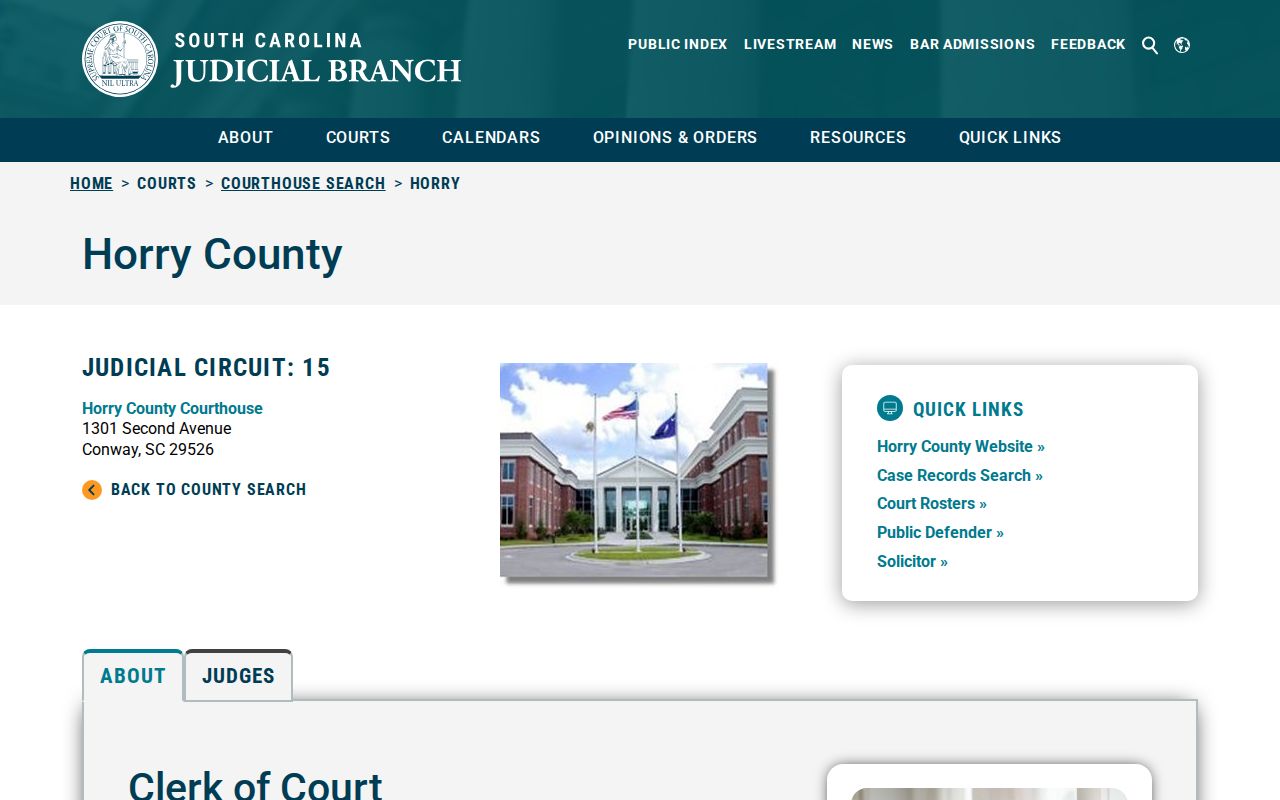
The court profile is an official way to orient a search, not a promise that every case or document is displayed online. Confirm the division and case venue before asking the Clerk for a permissible record or copy.
What a Horry Court Result Can Confirm
A Public Index result or detail may present a case number, parties, court agency, docket actions or events, case type, dates, status or disposition, and, where enabled, financial information or document icons. A case-number link can open the detail display, and an enabled Switch View can combine visible information. Document images are not promised for every matter, and the portal is not a certified record.
Since January 1, 2026, home addresses are not displayed for new or existing Public Index cases. Use a case number, venue, dates, middle initial, a matched parcel legal description, or a permitted Clerk response to separate same-name parties. For an actual or certified court file, request it from the Clerk division that matches the case. Give the case number, party names, date, division, and requested copy type. Court files are not obtained through County FOIA.
- Docket
- The dated sequence of actions recorded in a case. It identifies procedural events but is not an identity profile or a proof of residence.
- Index versus image
- An index is a finding tool that points to a record. An image is a copy of a document or display, and it may have separate availability, charge, or redaction rules.
- Certified copy
- A copy issued or authenticated by the court or other custodian for the purpose allowed by that office. A public portal screen is not the same thing.
South Carolina Vital Records Within Resident Lookup Limits
DPH covers South Carolina births and deaths from 1915 forward, marriage reports for July 1950 through December 2023, and divorce reports for July 1962 through December 2023. For an earlier or local marriage route, contact Horry Probate Court; for the actual divorce decree or court file, use the Horry Clerk. A DPH divorce report is not the court decree. These channels can corroborate an event or relationship when the requester qualifies, but they are not open-ended person searches.
DPH birth-certificate information explains the state request route and statutory boundary for a birth record.
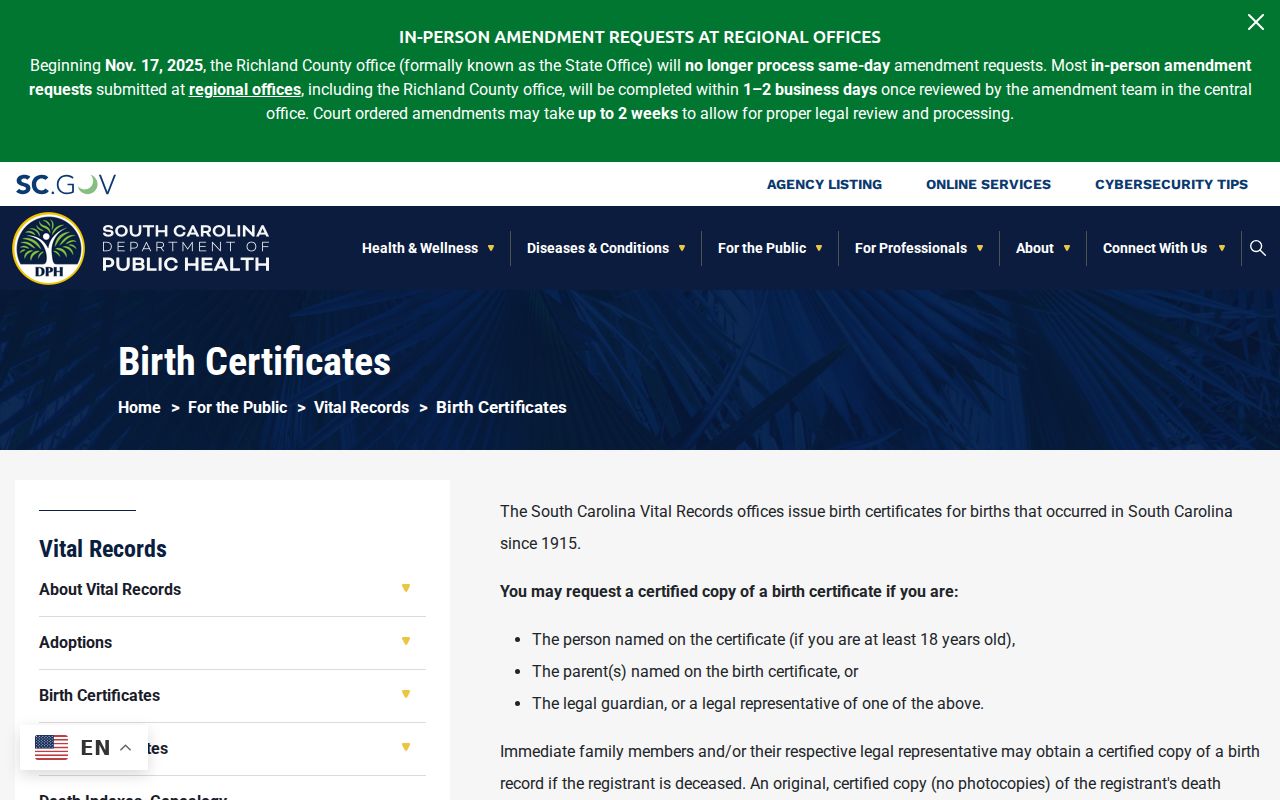
Under S.C. Code § 44-63-80, a certified birth certificate is limited to the registrant who is at least 18, a parent or guardian, or a legal representative. A birth record becomes publicly available for photographic viewing after 100 years.
DPH marriage-certificate information describes the report window and directs requesters to the appropriate local channel when needed.
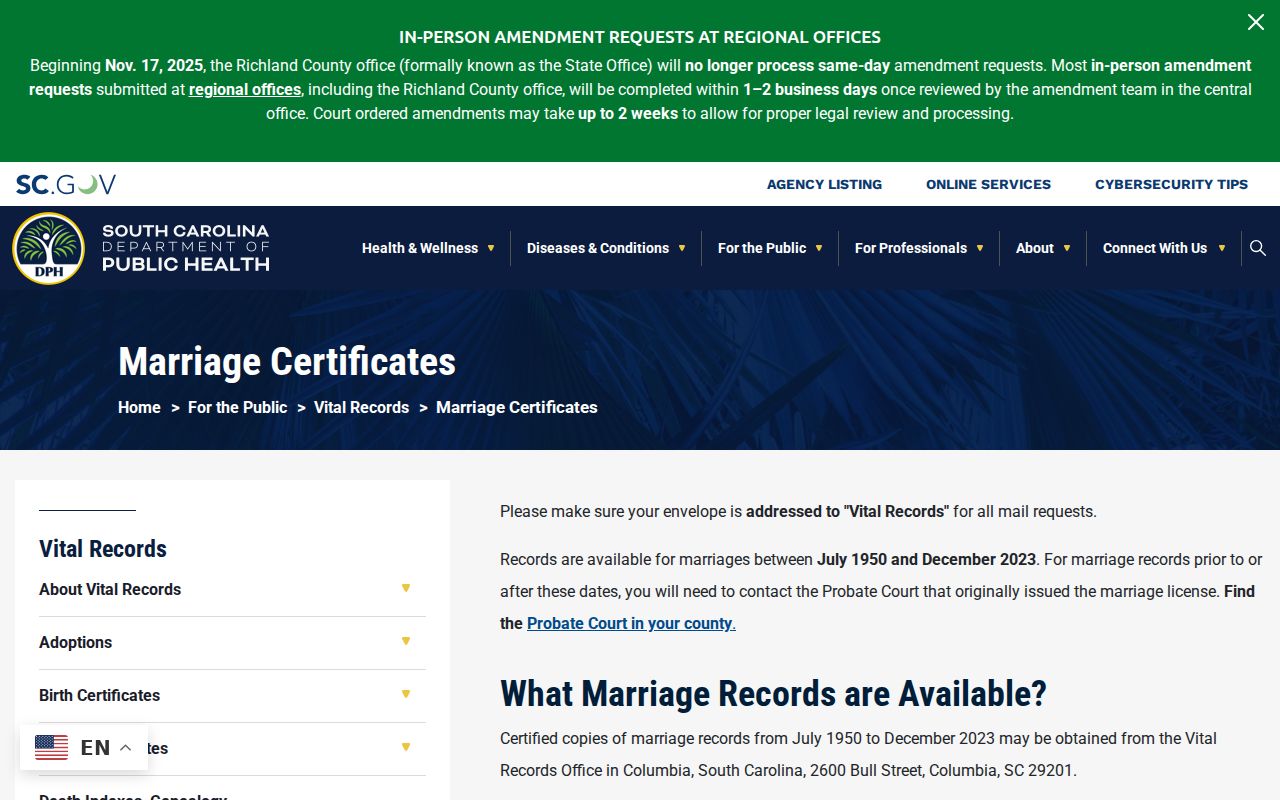
Section 44-63-86 limits marriage and divorce copies to parties, an adult child, a current or former spouse, or a legal representative. A person outside that group can receive only a statement of occurrence, date, and county rather than a certified record.
DPH death-certificate information provides the official death-record request path.
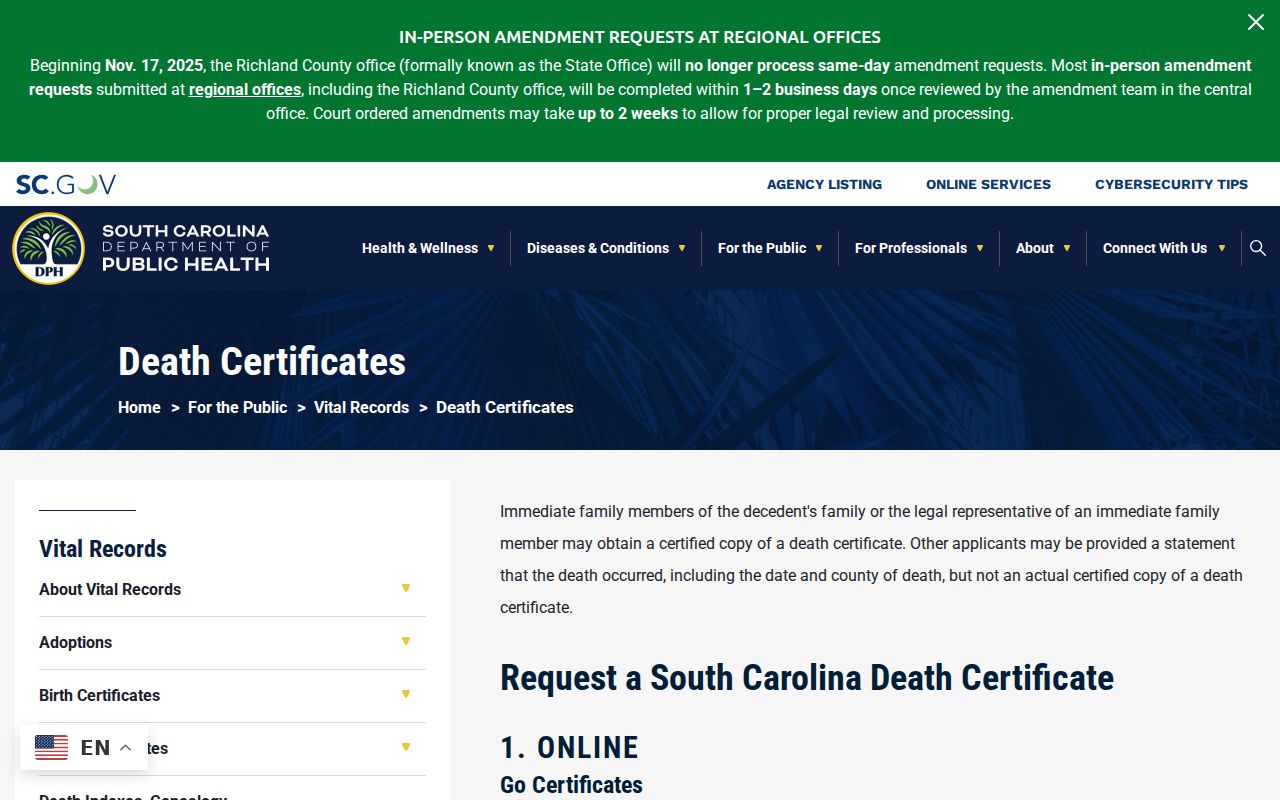
Section 44-63-84 gives limited death-certificate eligibility and makes death records public after 50 years. For genealogy, begin with the public-duration rule, cemetery, newspaper, obituary, probate, and archival leads rather than submitting an ineligible request.
The DPH consolidated vital-record request form documents applicant and event fields, relationship checkboxes, identification, payment choices, and a mail route to DPH Vital Records in West Columbia. It states a $12 search fee including one copy, $3 for each additional copy, and a $5 expedited fee for non-mail service. The form lists an approximately four-week mail estimate and a nonpeak in-person window; verify current details before submitting.
Verifying a Carolina Forest Resident Lookup Match
Use two independent sources plus a place or date before calling a name match correct. Normalize the name first: full name, initials, spelling variants, suffix, former name, organization name, and approximate date. Then connect it through a detail that is not merely the same name, such as a matched legal description, book and page, case number, event county and date, spouse or estate relationship, or credential number. Preserve the source path and the record date in the notes.
- Open the authenticated County parcel or tax record and record the Tax Map Number, legal description, current owner of record, and displayed address.
- Search Horry Acclaim by the relevant name, using the County's Last, First format without punctuation. Check the grantee route and a realistic date range, then record document type, date, book and page or instrument number, and legal-description memo.
- Compare the deed's lot, block, subdivision, unit, acreage, or legal description with the parcel. Do not substitute the owner mailing address for the property's physical location.
- If a court clue matters, search the Public Index by name and Horry filters, save the case number and date, and seek a permissible Clerk copy from the correct division.
- Use a vital, probate, cemetery, newspaper, entity, or credential source only where its date and relationship details independently fit the same person.
A same-name court, deed, license, obituary, or property result is not enough by itself. When the goal changes from one named person to the households along a road, use the separate address-focused Street Directory workflow rather than overreading a person record.
MySCVotes and the Official Voter Route
MySCVotes is a voter-login tool, not a browseable resident roll. It requires County, first name, last name, date of birth, and the last four digits of Social Security number, all matching the voter-card information. For a Carolina Forest voter, select Horry County. The legitimate purpose is a voter checking personal registration, precinct, polling information, or status. Those authentication fields must never be collected or repeated in a research log.
S.C. Code § 7-5-410 makes official registration records public for inspection, but inspection is not the same as the personal login route. South Carolina's official list-sale rules say a registered South Carolina voter may purchase a list subject to eligibility, fee, and use rules. The list route has its own filters and can include permitted registration and participation fields, but participation does not reveal ballot choices. The County Voter Registration and Elections office can resolve a voter’s own conflicting information or address update at 1515 Fourth Avenue, Conway, 843-915-5440, Monday through Friday, 8 a.m. to 5 p.m.
Historical Family Leads Beyond a Current Name Search
For an heir, historical relative, or former classmate, use a source that fits the time period. A public probate or court filing and a recorded document can point to an estate trail. Obituaries, the Horry Cemetery Project, historical newspapers, HCML, HCHS, and HCAC can help distinguish the correct family or locality. A cemetery entry can carry names, birth and death dates, symbols, and condition where the County project has inventoried a site, but it does not establish a present address. The County's historical planning material reports more than 15,000 gravesites in 250 or more cemeteries as a countywide project figure, not as a Carolina Forest cemetery claim.
South Carolina adoption records are confidential. The research did not capture a current official program name or page, so no purported registry or substitute route is offered here. Use only the State's official adoption-information, reunion, or intermediary program that applies, and do not treat a restricted certificate or a third-party profile as a replacement. For an older household, the historical volumes described in the City Directory guide can be paired with land, census, newspaper, cemetery, or probate evidence.
When the Official Trail Reaches a Custodian
An online nonmatch can reflect a name variation, date limit, access gate, wrong venue, index delay, protected record, or a record held only at the counter. Do not fill that gap with a guessed household member or residence. For pre-1984 recorded-name research, Acclaim's documented online name-result baseline is 1984 even though its date widget can accept earlier dates. Ask the Register of Deeds about books, plats, copies, and older research, then use HCAC's historic land microfilm or SCDAH for older legal-description material.
The Horry ROD copy-request form supports a mail route for a defined document. For a county administrative record not otherwise available, direct a focused request to the actual County custodian under the South Carolina Freedom of Information Act, S.C. Code Ann. § 30-4-10 et seq. A FOIA request is not the channel for a court-certified file, a restricted vital record, or an ROD document already available through the Register of Deeds. For a historical gap, HCML, HCAC, and HCHS are the documented library and archive alternatives.
Limits on a Carolina Forest Resident Lookup
South Carolina access rules protect more than just a missing search result. Public Index addresses are no longer displayed, juvenile, adoption, sealed, and expunged matters can be restricted, vital-record copies have statutory eligibility rules, and the Attorney General's Address Confidentiality Program can provide an eligible participant a substitute address under S.C. Code § 16-25-130. A protected or absent address may be intentional. It must not be bypassed or reconstructed from scattered records.
For a factual error, contact the record owner: the Assessor for property-tax or mailing-address questions, the Register of Deeds for a recorded document issue, the Clerk for a court-file question, DPH for a vital amendment, County or state election officials for registration information, or the relevant licensing board for a credential record. S.C. Code § 30-2-330 also offers a free written route to request redaction of listed personal identifiers from qualifying ROD or Clerk images. It does not erase a lawful recorded deed or case history.
Lawful use. Use official records for a respectful personal, historical, civic, or estate-related question. South Carolina's stalking and harassment law, S.C. Code § 16-3-1700 et seq., makes unwanted monitoring, threats, or harm unlawful; stop where a custodian or protection program limits access.